CHAMBER
Crank for String Quartet (2026)
Crank explores the idea of constant motion within a mechanical system. The music unfolds as a process set in rotation, built from short rhythmic and textural units that interlock and circulate between the instruments. Once in motion, the quartet resists stillness, sustaining energy through repetition, overlap, and gradual transformation.
Moments where the music slows or thins do not function as pauses or releases, but as recalibrations within the system. These decelerations suggest friction, resistance, or a temporary loss of torque—points where the mechanism strains, realigns, or redirects energy before continuing forward. Motion is therefore maintained not by uninterrupted speed, but by persistence. Rather than progressing toward a fixed goal, Crank remains in operation throughout, treating motion as an ongoing condition. The piece emphasizes endurance over arrival, presenting sound as a mechanism that continues to turn, adjust, and reengage.
Suite for Flute, Cello, and Harp (2025)
This trio for flute, cello, and harp is inspired by The Old Woman of Beare, an evocative 9th-century Irish poem that gives voice to a once-powerful woman reflecting on her lost youth, beauty, and influence. Believed to be a former queen, a poet, or even a goddess diminished by time, she speaks with both sorrow and defiance, lamenting the passing of her golden days while acknowledging the inevitable cycle of life.
The music seeks to capture the poem’s shifting emotional landscape—wistful memories of vitality and love, the relentless march of time, and the quiet acceptance of fate. The flute’s lyrical lines evoke echoes of her past, the cello provides a rich and mournful depth, and the harp—both celestial and earthly—grounds the piece in the tradition of ancient Irish storytelling. Through these timbres, the trio offers a meditation on impermanence, longing, and the enduring spirit of a woman who, despite her decline,remains unbowed.
Taranis for Brass Quintet (2025)
Taranis (2025) is inspired by the mighty Celtic god of thunder, revered as both a protector and a bringer of storms. Feared and honored by ancient peoples, he was believed to command the skies, unleashing lightning and thunder upon the earth. The Romans, recognizing his power, associated him with sacrifice and placed him among the most significant deities of the Gaelic pantheon.
Taranis' sacred symbol, the wheel, represented both the swiftness of the storm and the relentless movement of fate. Just as a tempest can rise suddenly and without mercy, his presence was felt in the unpredictable and overwhelming forces of nature. This piece seeks to capture the awe and reverence inspired by Taranis—an evocation of the storm’s fury, the weight of divine power, and the deep respect he commanded among those who worshiped him.
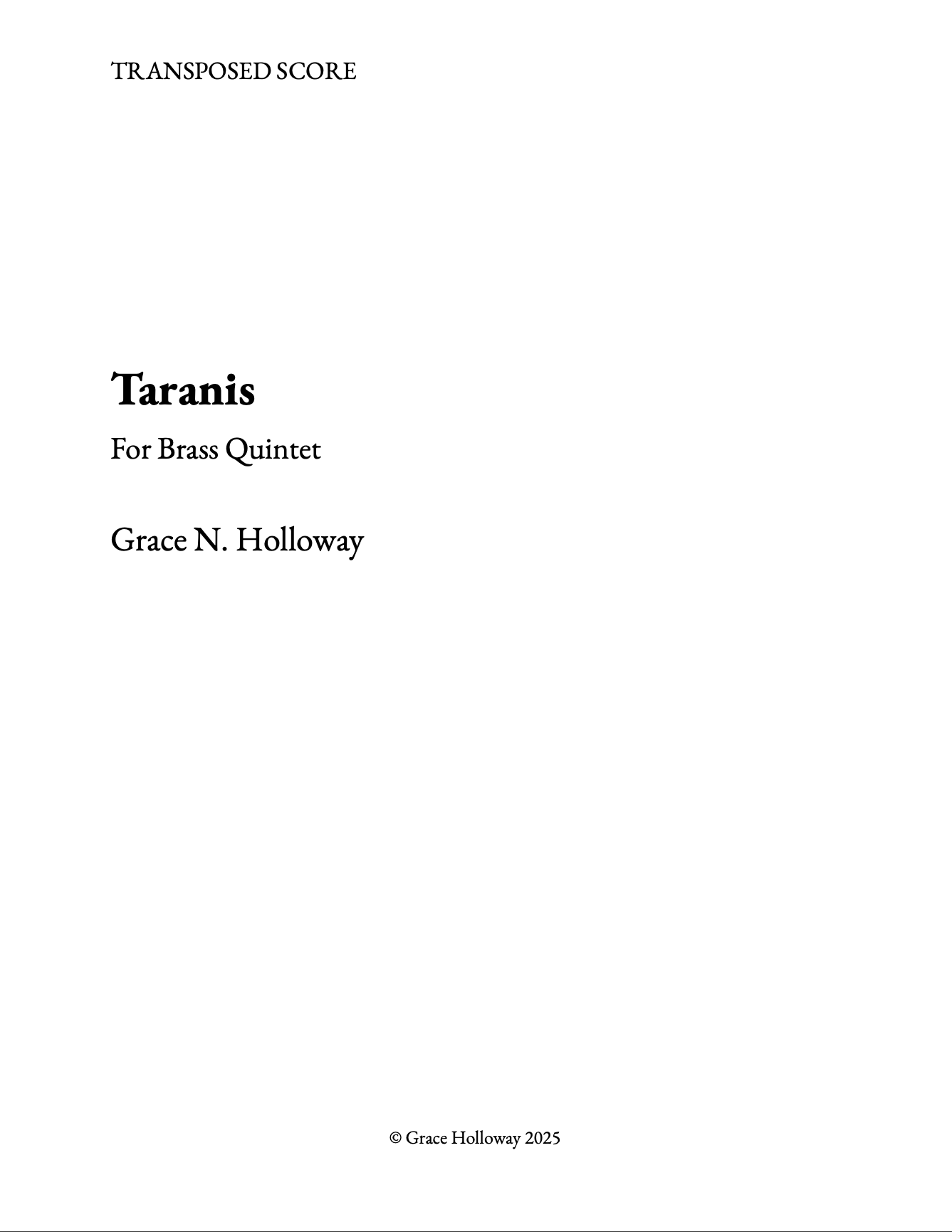
View perusal score.
LARGE ENSEMBLE
Dodecahedron for Orchestra (2025)
A dodecahedron is a twelve-sided Shape, long associated with harmony, proportion, and the mysteries of geometry. This orchestral work takes inspiration from that shape’s balance of symmetry and complexity. Rather than portraying any single “side,” the music turns each facet into a shifting plane of color, rhythm, and energy. The piece opens with tightly ordered, mechanical gestures—rigid patterns that suggest the geometric frame. Gradually, these structures begin to fracture and refract, revealing contrasting textures: luminous string sonorities, sharp brass outbursts, and shimmering percussion. As layers accumulate and rotate, the orchestra moves through sudden realignments, like the object being turned in light.
Dodecahedron isn’t a narrative piece; it focuses on how its musical ideas develop and shift. Clear patterns gradually loosen into more fluid textures, then return in new shapes. These changes give the work its sense of motion, with geometric principles acting more as a quiet guide than a strict blueprint.
SOLO
She Walks in Beauty for Solo Soprano (2025)
Lord Byron’s She Walks in Beauty (1814) is one of the most famous Romantic poems, celebrated for its lyrical elegance and evocative imagery. Inspired by a moment of admiration, the poem describes a woman whose beauty is not just physical but also reflects inner goodness and grace.
Byron masterfully contrasts light and darkness, suggesting that true beauty arises from a harmonious balance between the two. The poem’s soft and flowing rhythm mirrors the gentle, effortless charm of its subject. Though written in the 19th century, its themes of admiration, serenity, and moral beauty remain timeless.
For scores and inquiries, contact me.
Sparkle Funk for Solo Piano (2024)
Sparkle Funk, informally known as Soft Kitty Brown-Brown, is a solo piano composition that draws inspiration from blues elements, unconventional time signatures, and vibrant chord progressions. While it playfully nods to works by Nikolai Kapustin and the Chinese composer-pianist A Bu, the piece retains the distinctive "sparkly" style characteristic of my broader repertoire.
The informal title, Soft Kitty Brown-Brown, emerged spontaneously upon completing the piece, evoking the image of a mischievous cat darting about in chaos. However, it is admittedly less suited for the formality of a concert program.
For scores and inquiries, contact me.
Nature Meditations for Solo Piano (2023)
A four movement solo piano piece inspired by nature
For scores and inquiries, contact me.